As the financial inclusion sector shifts toward making financial health a central goal of financial sector policy and as uncertainty continues to be the hallmark of our current landscape, understanding drivers of vulnerability for people who have access to formal financial services can serve as an important element to improve the design and delivery of products for better outcomes.
A core argument for financial inclusion has been its potential to reduce consumer vulnerability, and growing evidence supports this contention, showing that access to a safe place to save, affordable credit, and low-cost payments can help people anticipate, absorb, and recover from shocks. For example, Fernández-López et al. (2023) show that “highly financially included” individuals are more likely to exhibit financial resilience. However, it is also clear that financial inclusion may support but is not, in itself, sufficient for driving resilience, defined as the capability to bounce back from a shock. Access to formal financial services does not guarantee resilience. For instance, a person can hold an account and still remain acutely vulnerable. Data from the Global Findex 2025 makes this evident: account ownership reached 79 percent globally, yet nearly half of adults in developing economies cannot raise emergency funds quickly. Using Findex data, it can be estimated that nearly 4.3 billion adults were financially vulnerable in 2024.*
The increasing volatility, uncertainty, complexity, and anxiety of the current global context has also exposed and generated new forms of vulnerability from well-meaning financial inclusion efforts. Take for instance digital credit extended to thin-file borrowers, delivered instantly through a phone, which has produced over-indebtedness at scale in several markets. Inclusion with the wrong product, on the wrong terms, is not neutral. It can, in fact, manufacture the very fragility it was meant to cure. Looking ahead, the question is therefore increasingly not about maximizing inclusion. Rather, it is about optimizing the forms of inclusion which best mitigate vulnerability in the midst of manifest uncertainty.
What Do We Mean by ‘Vulnerability’?
Consumers are vulnerable when their exposure to economic and financial shocks exceeds the abilities of their buffers and support options to cover. If their buffers are adequate to weather these shocks, then despite the exposure, they are considered non-vulnerable. The concept of financial health developed and applied widely over the last decade layers additional elements on top of non-vulnerability, so that a financially healthy consumer is also non-vulnerable but it does not follow that all non-vulnerable consumers are financially healthy if they do not meet the additional criteria.
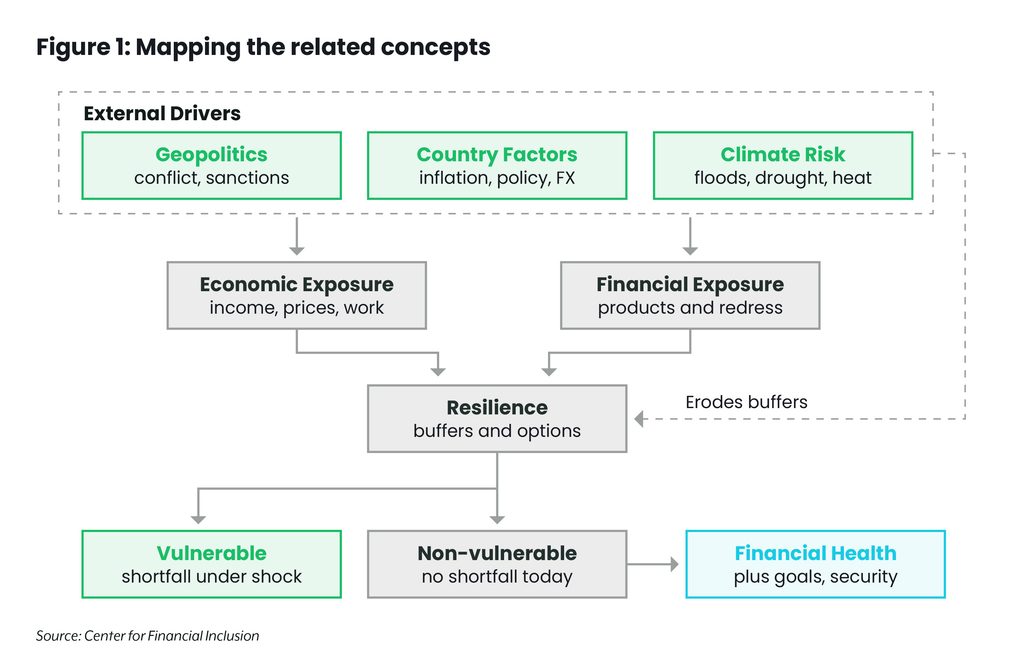
Most frameworks today describe vulnerability along a set of dimensions and treat it as dynamic rather than fixed. For example, the UK’s Financial Conduct Authority (FCA) defines a vulnerable consumer as “someone who, due to their personal circumstances, is especially susceptible to harm, particularly when a firm [referring to a financial service provider] is not acting with appropriate levels of care.” The FCA frames vulnerability as a spectrum driven by four characteristics:
- Health: conditions or illnesses that affect the ability to carry out day-to-day tasks;
- Life events: major changes such as bereavement, job loss, or relationship breakdown;
- Resilience: low ability to withstand financial or emotional shocks;
- Capability: low knowledge or confidence in managing money, including low digital capability.
This approach combines sources of economic and financial exposure. One could argue that there is also physical exposure to contend with for some segments of users. Rising heat exposure can result in health issues, and for others can create additional financial strain as they are forced to purchase air conditioners. Others suffer income loss as they find ways to cope. The result is that vulnerable consumers are not a fixed group: their ranks may fluctuate since the vulnerability may be transient, situational, or permanent.
Vulnerability may also arrive suddenly. The G20/OECD High-Level Principles on Financial Consumer Protection (updated in 2022) and the international standard in this field, take a similar approach, stating vulnerability stems from personal circumstances or external factors, including age, income, health, and digital literacy, as well as life events, systemic barriers, and broader economic shocks. Academic Peter Cartwright has developed a taxonomy of the sources of consumer vulnerability, identifying (lack of) information, sales pressure, failure of supply, lack of redress, and impact.
The scholarly literature, surveyed comprehensively by Fernández-López and colleagues, converges on vulnerability as a function of three forces: exposure to shocks, sensitivity to them, and resilience in the face of them. A household is financially vulnerable when it cannot meet monthly expenses, falls into arrears, or cannot balance a budget; all conditions that overindebtedness sharpens but does not exhaust. Interest in the concept of vulnerability rose sharply after the 2007–2008 crisis and has stayed high, because the same mechanism explains distress in rich and poor economies alike: a gap between the size of a shock and the resources available to absorb it.
Where regulators emphasize the firm’s duty of care, academics emphasize measurement which includes financial literacy, social capital, and access to liquid resources as the components of resilience. We see these approaches as being complementary. One tells firms what to do; the other tells analysts what to count.
A working definition of vulnerability
Vulnerability is a state in which a person’s exposure to economic and financial shocks exceeds their capacity to absorb them without lasting harm — shaped by health, life events, low resilience, and low capability, and made better or worse by how markets and providers treat them. It is dynamic and relational.
Measuring the Vulnerable but Included
Mapping precise definitions of vulnerability as Fernández-López et al. do, requires access to comprehensive datasets which are not globally comparable. However, the World Bank’s Global Findex Database provides a globally comparable dataset with which to consider at least proxies for vulnerability. The Global Findex 2025 did not ask about vulnerability directly, but probed the resilience-related question: “If you needed emergency funds equal to 1/20 of GNI per capita, could you come up with that amount within 7 to 30 days?”
From 2021 onward the question adds a difficulty scale layered on top of “possible” — i.e. respondents who say it’s possible are further asked how difficult it would be, producing effectively a 3–4 point ordinal scale: not possible → possible but very difficult → possible but somewhat difficult → possible and not difficult. Using these measures, we can identify two layers of vulnerability: severely vulnerable individuals indicate that coming up with the emergency funds would either “not be possible” or “possible but very difficult,” and moderately vulnerable individuals indicate that coming up with emergency funds would be “possible but somewhat difficult.”
Calculating how vulnerability intersects with financial inclusion, we find that some 2.42 billion people, or 53 percent of all global adults are both included and vulnerable. More tellingly, 38 percent of those that are included are still severely vulnerable.
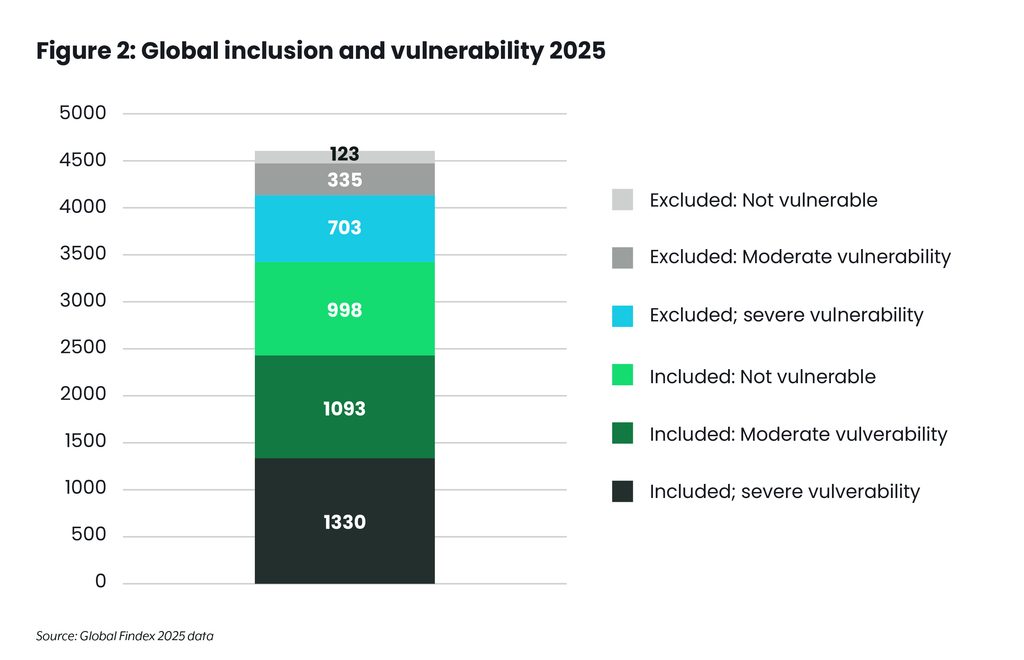
These proxy questions have been asked consistently in the last two waves of Findex surveys enabling a trend between 2021 and 2024. However, a change in methodology in 2021 makes comparing prior data difficult.
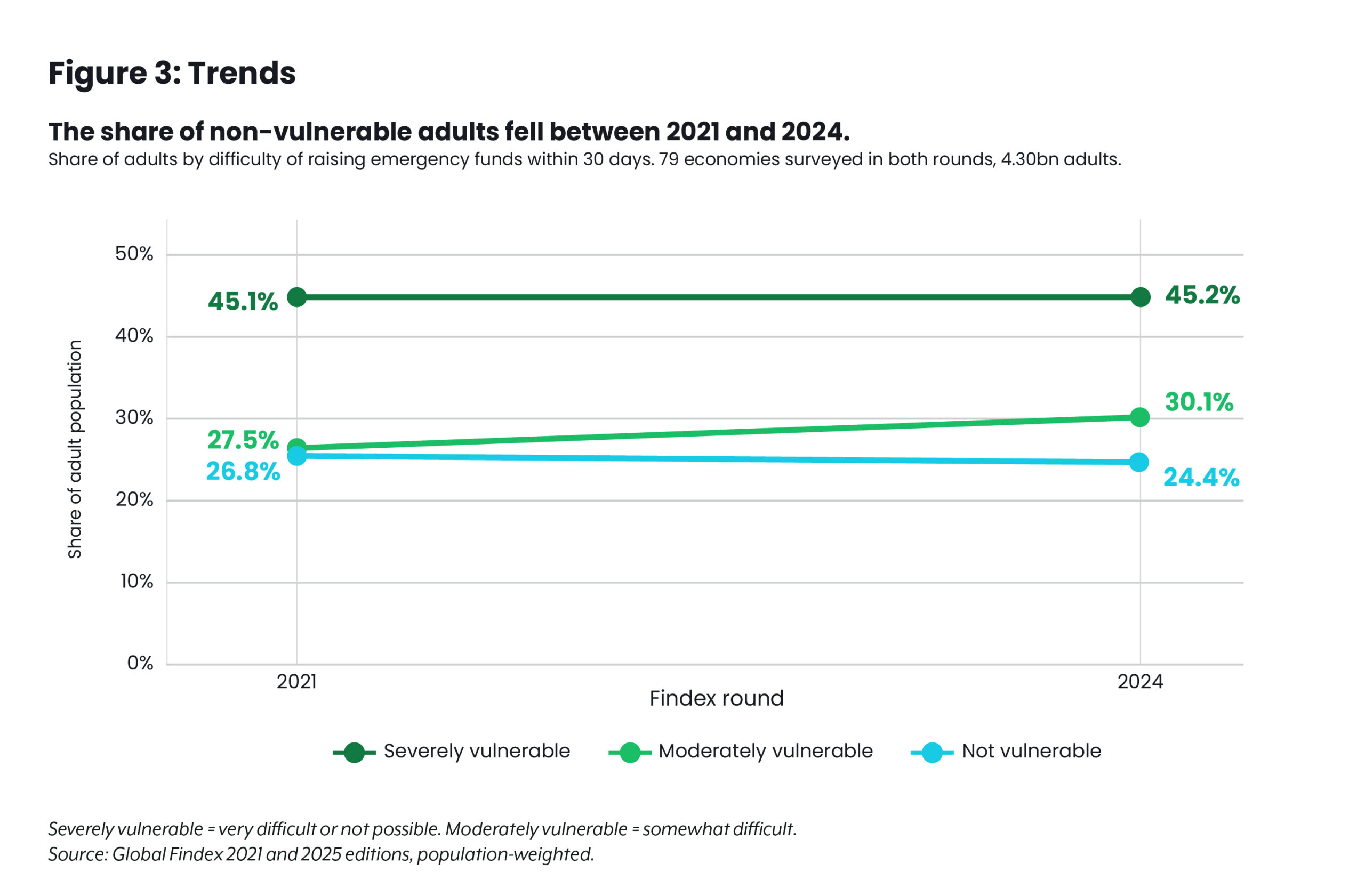
Figure 3 shows that while the percentage of severely vulnerable adults has remained high between 2021 and 2024, the number of non-vulnerable adults has dipped slightly — corresponding to an increase in moderate vulnerability.
A closer look at the included and vulnerable segment, including “moderately vulnerable” and “severely vulnerable” individuals.
- They borrow more than anyone else, and they borrow to eat. Borrowing at 66.4 percent tops all four groups, above the excluded vulnerable at 56.0 and the included non-vulnerable at 58.0. Food bought on credit is 37.9 percent, and borrowing for medical costs is 30.1 percent, both the highest of the four segments.
- They do not have a buffer. 42.2 percent save, compared to 84.0 percent for the included non-vulnerable, and saving in formal financial institutions is 23.0 percent compared to 70.3 percent.
- They are also the group most exposed to digital harm. Findex data explores the issue of scams by asking if “an individual fell victim to a scam the last time they were approached by a scammer over mobile phone.” This greatly underestimates the incidence of scam losses. Even with this imprecise measure, however, it is clear that the included and vulnerable segment is the most exposed. Scam loss at 1.2 percent for this group is double the included non-vulnerable and four times the excluded vulnerable.
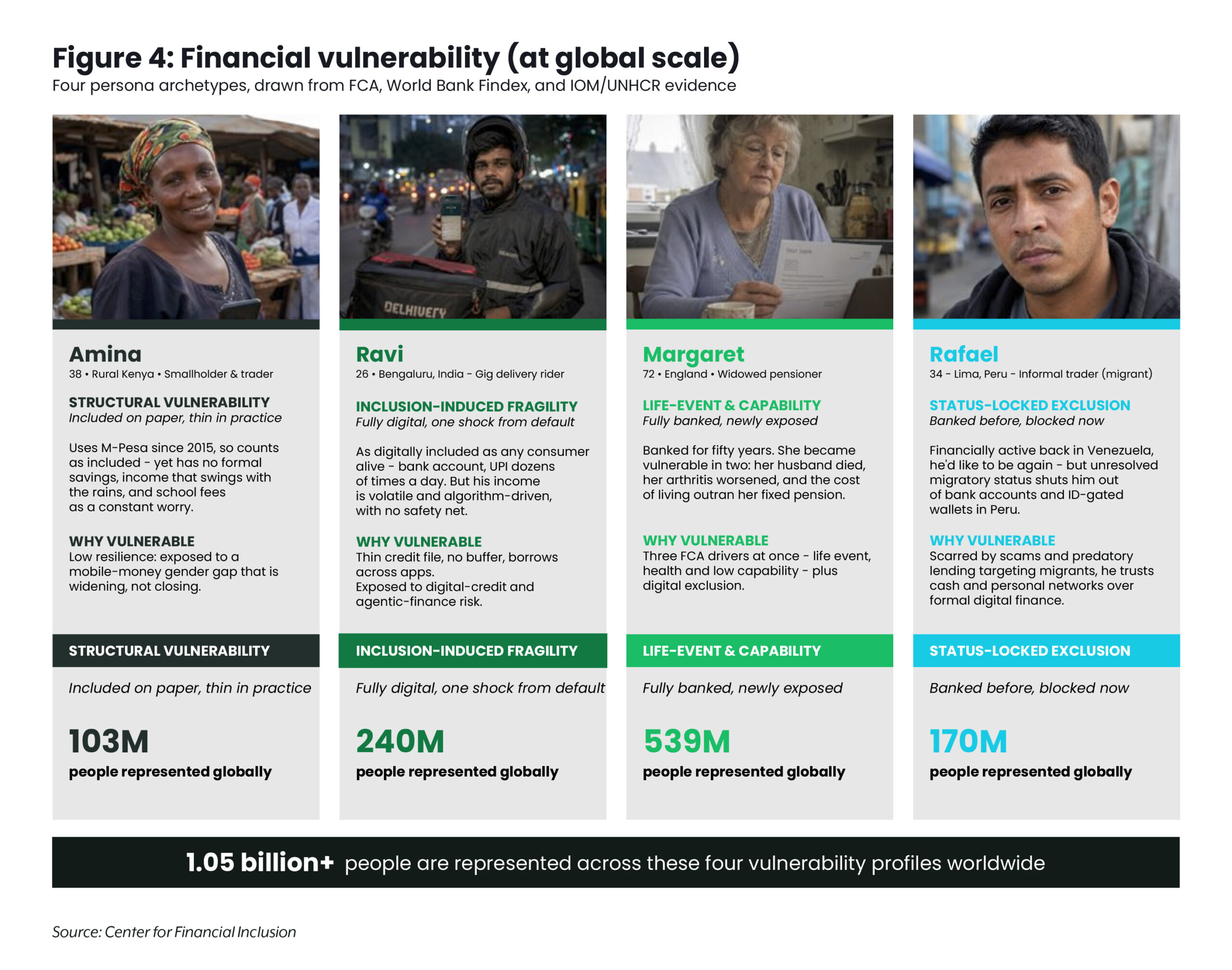
The included vulnerable is a large and diverse group. To put faces to the group, we constructed personas who collectively represent just over 1 billion (or 42 percent) of the vulnerable but included group.
Why Does the Vulnerability of Included People Matter Now?
While account ownership has risen from 51 percent in 2011 to 79 percent of adults in 2025, the majority of included people today remain vulnerable. Since the sources of vulnerabilities are not only related to livelihoods and income, these do not resolve even if incomes rise. In the next five years, systemic changes may further stress household balance sheets which are already under strain. Agentic finance is arriving first as a modifier of exactly those market-side vulnerabilities, with adoption among emerging markets and developing economies (EMDE) institutions running ahead of advanced-economy peers and supply-side deployment running well ahead of anything consumers hold, which sets the default distribution of benefit before rules are written. At the same time, the funding and policy architecture that has underwritten financial inclusion has already shifted in the past two years and will shift further in the years to come. Vulnerability is the variable that determines whether the inclusive finance system leaves people better able to absorb shocks or more efficiently exposed to them, and the arrangements that settle it are being made now.
When the Responsible Finance Forum (RFF) meets in Singapore in November 2026, RFF members, including representatives of regulators, financial institutions, funders and researchers, will be exploring the next five years of responsible finance to understand how to increase resilience and achieve positive financial health outcomes. In the face of the uncertainty and complexity, the Center for Financial Inclusion is convening a scenario building project built around seeking answers to this question:
What actions can different RFF actors take by 2030 which will result in a more resilient, responsible, and inclusive financial system for vulnerable but included consumers?
In the run up to RFF 2026, we will be developing plausible stories about the different possible pathways to better consider what it now means to be responsible in the next five years. We expect to be able to share these with the wider financial inclusion community for further engagement afterwards.
*Note: Findex data shows whether respondents report that it is difficult to come up with emergency funds equal to one-twentieth of gross national income per capita. We use this measure as a proxy for financial vulnerability and impute data for countries not measured in 2025 to come to a global population estimate. The imputation extends the average percentage of financial vulnerability for each country income group to unmeasured countries. 708 million of the 4.263 billion figure is imputed. Percentage numbers reported in this article do not use imputation.
Photo credit: olli0815
Authors



Explore More