In a recent experiment, Google’s “AI Blackbelt” Heiko Hotz asked an AI shopping agent to buy a waterproof hiking jacket for the Scottish Highlands. One merchant offered a $90 jacket using typical marketing copy designed for human customers: “Ultra-breathable all-weather shell. Conquers stormy seas!” Another offered the same jacket for $95 using machine-readable JSON data {"water_resistance_mm": 20000}. The agent chose the more expensive jacket every time, filtering out the cheaper product because it could not understand the marketing language designed for human readers. The cheaper jacket lost because the machine could not read it.
This small experiment points to what could become a larger shift in financial inclusion and the broader digital development agenda. Consumers and merchants face different but interrelated risks. For consumers, the central issue expands beyond barriers to access, such as financial literacy, transparency, and consumer capabilities, to include risks linked to safe delegation and intent alignment. In this case, the buyer in the jacket example reduced search costs but still paid $5 more. For small businesses, participation in the digital economy may increasingly depend on their legibility to AI agents. Being digitally present is no longer sufficient if agents cannot interpret what a business offers. Small firms will compete for customers and, increasingly, for the machines that choose on customers’ behalf.
Views on the potential of agentic commerce remain sharply divided. Several industry analysts have voiced skepticism, defining agentic commerce as a “collective hallucination” and a “mirage,” arguing that consumers may resist delegation, merchants may avoid new integration costs, and the governance needed for agentic commerce may have too many points of failure. Others take a more cautious stance: fully delegated purchasing is unlikely in the short term, while AI-mediated search and discovery are already influencing how consumers find products and which merchants are visible.
For small businesses, participation in the digital economy may increasingly depend on their legibility to AI agents. Being digitally present is no longer sufficient if agents cannot interpret what a business offers.
The inclusive finance sector is grappling with whether to engage early while agentic commerce is still nascent or wait for the market to mature and become harder to influence. Important design choices and standards are being set now. New philanthropic capital invested by frontier labs and tech platforms could help ensure that inclusion agendas and consumer protection are prioritized before business models and infrastructure are fully entrenched. The case for caution is equally strong. Many applications remain at pilot stage and fully delegated purchasing remains limited.
This brief does not aim to predict whether agentic commerce will succeed. It starts from the premise that the market will struggle to scale unless trust, protection, accountability, and inclusion are built in early. The brief focuses on three interrelated agendas: consumer protection, small business digitization, and inclusive digital infrastructure. Protection agendas will determine how agents act on behalf of users, what safeguards are needed, how redress works, and who is responsible when agents cause harm or losses. Digitization agendas will have to evolve beyond participation in e-commerce and digital platforms toward machine readability and interaction with AI agents. Protocols and infrastructure will determine which firms agents can read, defining the preconditions for participation and exclusion. The sections that follow ask a practical question: What should inclusive finance try to influence before early design choices become market defaults?
Rethinking Consumer Protection in the Agentic Economy
Agentic commerce is still nascent, but early controversies already reveal the consumer and seller protection issues likely to matter. Several incidents since 2025 illustrate the risks.
- Amazon tested “Shop Direct” in 2025, listing products from third-party vendors and allowing consumers to buy from them through Amazon. Independent retailers protested that Amazon had scraped their data without permission, including inaccurate listings of out-of-stock or mislabeled items that led to customer complaints.
- The U.S. retailer Target partnered with Google in 2026, allowing customers to use Gemini to suggest products and complete purchases on their behalf. The partnership drew attention when Target updated its Terms and Conditions, stating that errors by authorized AI agents would be treated as the shopper’s responsibility, including intent misinterpretation, wrong purchases, or other errors.
- The Civil Resolution Tribunal of British Columbia forced Air Canada to partially refund a customer misled by the company’s chatbot about its bereavement fare policy. The chatbot encouraged the customer to buy the ticket at full fare and apply for the bereavement fare retroactively, which was against policy. The case became an early example of the question at the heart of agentic commerce: Who is responsible when automated systems make mistakes?
These North American examples point to structural issues in agentic commerce that matter in emerging markets as well. The incident with Amazon raises questions about who controls the data agents use and who bears the consequences when agents misprice or provide inaccurate information. Target and Air Canada expose a key liability question: When agents make mistakes, who pays? The space is contentious. Advocates of innovation argue that light regulation will enable growth and efficiency gains, eventually benefitting consumers at scale. Pro-consumer advocates counter that early experimentation cannot come at the expense of early adopters. Delegation can move faster than liability.
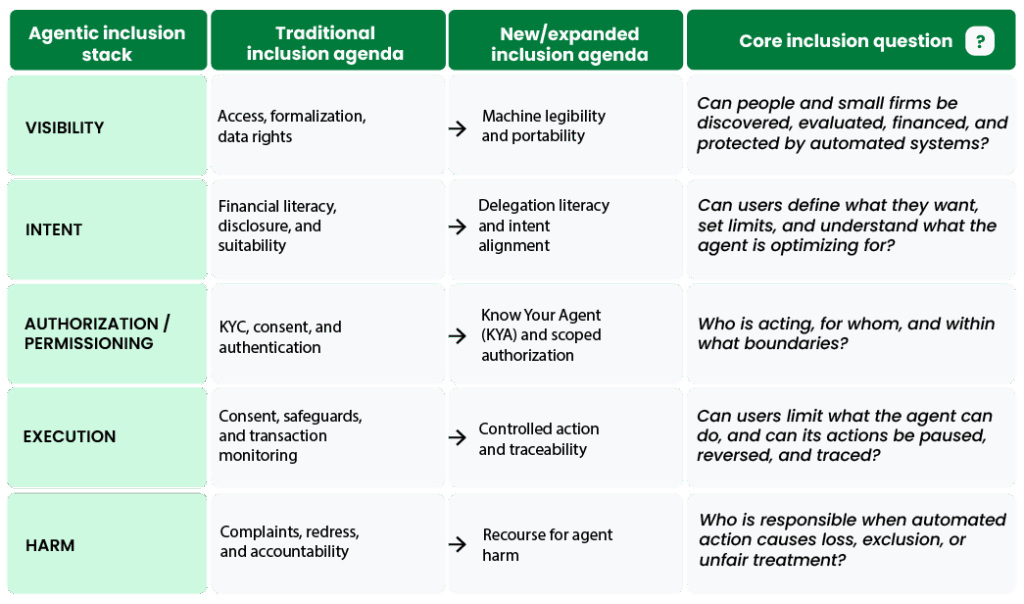
The early implementation of agentic commerce creates an opportunity to design consumer protection with inclusion in mind from the outset. Traditional focus areas in financial consumer protection and market conduct such as transparency, adequate disclosure, consent, and suitability remain critical. Agentic commerce adds new points of failure. Financial literacy, for example, needs to expand through the lens of delegated agency: how to articulate intent, how to scope and limit delegation, and how to act in case of harm. KYC processes may expand to KYA (Know Your Agent), ensuring that agents act on legitimate authorizations and within clear scope. Transparency and disclosure will increasingly depend on whether information is machine readable. The table below maps these shifts.
A New Agenda for Small Business Digitization in the Agentic Economy
Agentic commerce creates a more complex inclusion landscape than traditional digitization agendas currently capture. In agentic markets, financial inclusion and machine readability become distinct conditions for participation in the digital economy. A small business may be financially included but invisible to agents if its records cannot be read. A gig worker or informal retailer may be highly visible through platform data, yet still lack access to adequate credit or insurance. This creates new levers for opportunity but also new forms of exclusion.
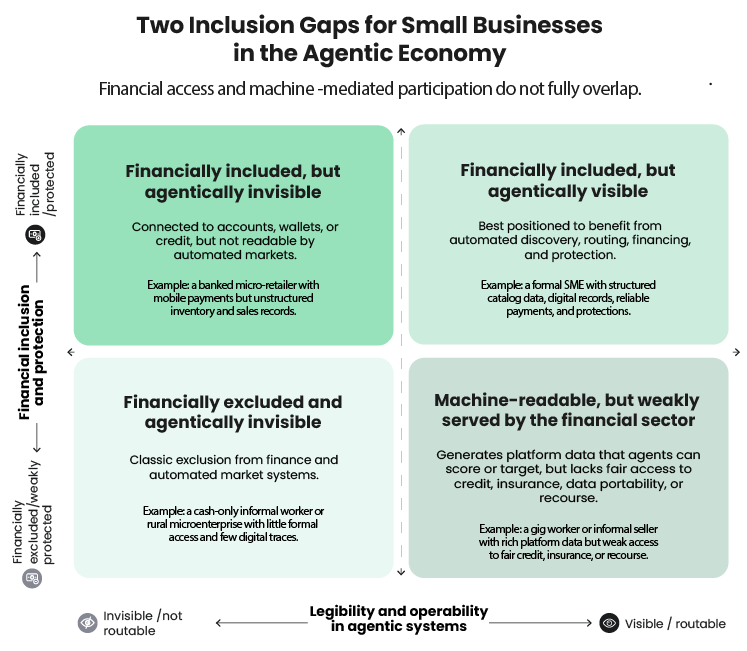
The matrix shows that financial exclusion and machine invisibility can become compounding barriers. Although the two barriers are distinct, they can reinforce each other. Small businesses with limited access to finance may struggle to invest in developing structured data, APIs and inventory systems needed to become visible in agentic economies. On the other hand, firms that remain invisible to AI agents will lose sales, transaction histories and key data needed to access adequate credit, insurance and other financial services. Some firms will remain outside both formal finance and agentic markets. The best-positioned businesses combine financial services with structured data. The policy challenge is to prevent financial exclusion and machine invisibility from compounding each other, ensuring that participation in agentic markets does not depend on resources that smaller firms are least able to afford.
The business digitization agenda will need to expand in at least three directions:
- New capabilities for small businesses in the agentic economy: Small businesses will need new capabilities to meaningfully participate and grow in the agentic economy. This includes “machine readability:” creating structured records, inventory, and catalogs so they can be visible to AI agents. Small businesses will also be users of agentic commerce, requiring capabilities around articulating intent, safe delegation, scope limitation, and fraud/scam prevention.
- Improving the ROI of participation in the agentic economy: Digital transformation in the agentic economy will come at a significant cost for entrepreneurs while returns remain uncertain, especially before the market scales. Costs include the time and money needed to develop structured catalogs, build and maintain APIs, continuously update inventory, and deal with errors and inaccuracies in agent-driven transactions. A new agenda in digital development should focus on driving the costs of participation down as low as possible, ensuring that machine-readability does not become a new barrier to entry to the digital economy.
- Making business data portable and interoperable: The ROI of investing in structured data and business processes will increase if entrepreneurs can reuse that data across platforms and with financial services providers. On the other hand, platforms may be incentivized to create “walled gardens,” where data and access to embedded financial services remain within the platform. Entrepreneurs benefit when they can switch easily and access new markets and platforms with competitive offers. Achieving interoperability will require shared infrastructure and enabling policy environments.
The Infrastructure Race Has Already Started: Lessons From and for the DPI Agenda
In May 2026, at Google I/O, Google previewed the agentic commerce experience it is trying to build. Its Universal Cart would allow users to add products while searching online, watching YouTube, or reading emails. An agent would work in the background, finding deals, applying loyalty benefits, and helping complete checkout. At the time of writing in October 2026, Google described Universal Cart as rolling out in the U.S. “this summer,” so it should still be treated as an announcement rather than a market reality.
The more important discussion is the underlying protocol that enables agents to operate and execute transactions on behalf of customers. AI agents will need dedicated rails, protocols, and institutions that define how they operate and the limits to what they can do. Google’s Universal Cart is supported by the Universal Commerce Protocol (UCP), an open-source standard created with partners including Shopify, Walmart, and Target to create a common language for agents, merchants, and payment providers. UCP will define data and mechanisms agents use to compare products, verify offers, and route transactions. For small firms, those technical requirements could become a condition for visibility in the agentic economy. Standards can become gatekeepers.
The race to build the infrastructure and orchestration layers of agentic commerce is highly competitive and rapidly evolving, with large tech companies at the forefront. Payment networks, e-commerce platforms, and cloud companies are also building pieces of the rails. These systems will shape participation, exclusion, consumer protection, and redress. As Box 1 shows, the infrastructure is complex and fragmented, with unresolved questions around governance and liability.
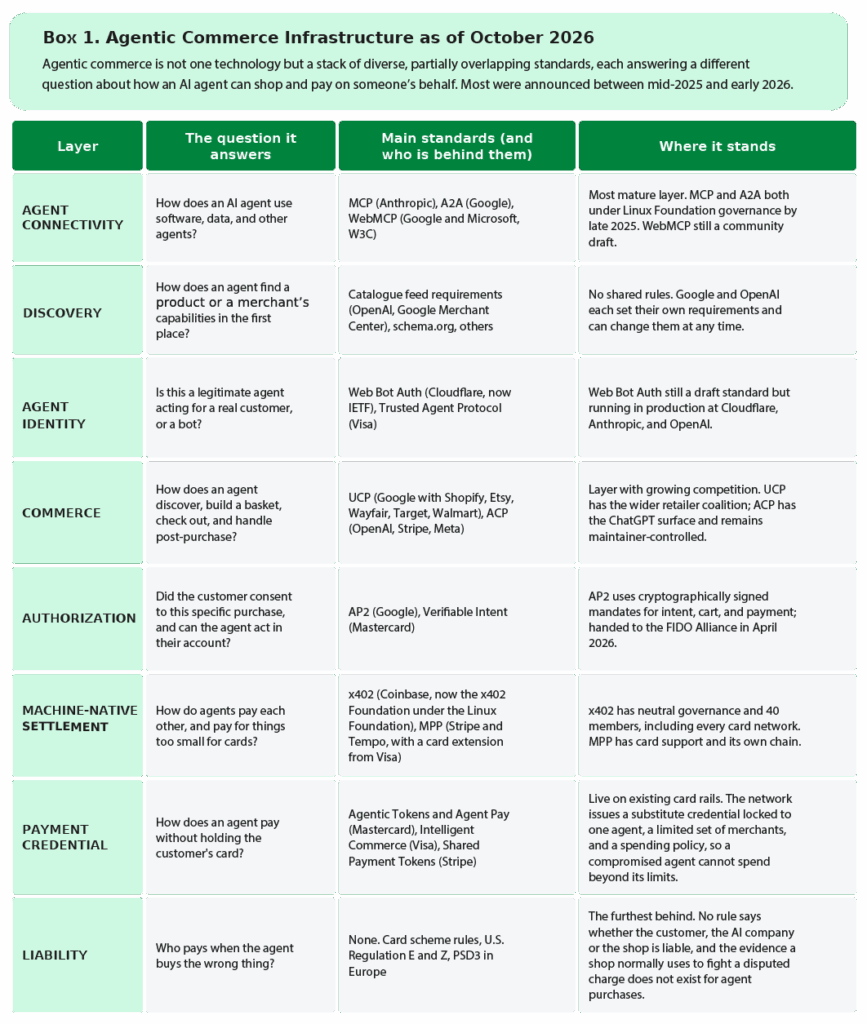
The immediate question for the inclusive finance sector is how to bring a DPI lens to a market that is still being built privately. Agentic commerce is too early for most governments in emerging markets or development organizations to treat as public infrastructure, and too uncertain to know where interoperability and coordination will be most needed. It is also far enough along for standards, data requirements, payment credentials, and liability assumptions to start taking shape. New non-profit initiatives are starting to shape these conversations. The Agentic AI Foundation, co-founded by OpenAI, Anthropic, and other major tech firms under the Linux Foundation, aims to provide a neutral home for interoperability and governance. The FIDO Alliance has emerged as a coordination point for trust in agentic payments, bringing together Google’s AP2 protocol and Mastercard’s Verifiable Intent. These conversations would benefit from closer engagement with inclusive finance organizations that understand market dynamics, institutions, and policy environments. Stronger participation from the financial inclusion community could help shape design choices and rules around merchant discoverability, transparency of recommendations, data portability, and user controls. It could also help keep the cost of participation as low as possible for micro and small merchants, so that machine-readability and compliance with new standards do not become a new barrier to entry.
Toward a New Inclusive Finance Agenda: A Role for Catalytic Philanthropy
Agentic commerce may face slow adoption, but the inclusion agenda should not wait for the market to mature. Despite the uncertainty, AI agents are expanding their role in shaping consumer demand, executing payments, and determining which businesses are visible and which are left out. Inclusive finance organizations should engage early, building expertise and influencing technical design choices and rules of participation, including transparency obligations, while the market is still forming.
The inclusion agenda will need several pillars supporting a common outcome. Consumer and seller protection rules will determine how harm and losses are dealt with, and who is liable when errors occur. Digitization agendas will evolve around machine readability, agentic capabilities, cost, and data portability. Digital infrastructure actors will determine whether technical requirements widen participation or become a new source of exclusion for firms that lack the resources to adapt. Roles will differ: consumer protection organizations on safeguards and redress, small-business and inclusive finance actors on capabilities and digitization agendas, and infrastructure and standards bodies on open participation and portability. Inclusion in agentic markets is a systems problem, which will be achieved by having multiple players aligned toward a common outcome.
Catalytic philanthropy has an important role to play in the early phases of market development. Where commercial viability remains uncertain, philanthropic capital can fund research and experimentation on how agentic commerce affects lower-income consumers and small businesses, and support the digital capabilities and shared infrastructure small firms need to participate. It can also test new approaches to consumer and seller protection, including guarantees or insurance against losses caused by agent errors. Protection may become a product, not just a rule.
Philanthropic capital can also support organizations that bring an inclusion perspective into technical and commercial conversations led largely by technology companies, payment networks, and frontier labs. Inclusive finance organizations, nonprofits, consumer associations, small-business groups, and technical experts can participate in standards and rule-setting, test their implications in emerging markets, convene regulators and industry, and ensure that small businesses and lower-income consumers inform key market design decisions. The window of opportunity for philanthropy is before technical choices become market rules, when inclusion and consumer protection agendas can be embedded in how the market is shaped.
The inclusive finance sector will face a period of heavy rethinking as earlier inclusion agendas adjust to markets shaped by AI agents. Making markets work for the long tail of micro and small businesses will require research, experimentation, data infrastructure, and dialogue across industry, government, and citizens. Inclusive finance organizations should ensure that lower-income consumers and small businesses are represented and that tensions between innovation, competition, protection, and inclusion are addressed openly. The goal is to ensure that the $90 jacket merchant from the opening example is not excluded by rules written for machines, and that the consumer relying on the agent is not left paying for choices they did not fully understand or control.
Acknowledgments: The author is grateful to Matt Scharr, Devraj Hom Roy, Nataša Goronja, Anindita Chakraborty, Luz Gomez, and Carolina Zuluaga for their substantial inputs and guidance, and Sofia Huizar for editorial oversight. This work was supported by the Mastercard Center for Inclusive Growth, whose support has enabled CFI to explore emerging questions at the intersection of technology, small business inclusion, and the future of financial services.
- Small businesses must be machine-readable, not just digitally present, to compete. Machine readability is becoming a distinct condition for participation in agentic commerce. Structured data, APIs and inventory systems needed to become visible in agentic economies may determine whether AI agents widen the exclusion gap for underserved firms or compound the advantage of those already visible to machines.
- Agentic commerce infrastructure choices made now may become market defaults. The protocols and standards governing discovery, identity, authorization, and payment are being set largely by technology companies, payment networks, and frontier labs, and they will shape which firms AI agents can read and how redress works.
- The financial inclusion agenda should not wait for agentic commerce to mature. Adoption may be slow, but consumer protection, small business digitization, and digital infrastructure agendas are already taking shape. Engaging early will require the sector to rethink as earlier inclusion agendas adjust to markets shaped by AI agents.
- Catalytic philanthropy plays an important role in the early phases of agentic commerce. Philanthropic capital can fund research and experimentation, support shared infrastructure and new protection models such as guarantees or insurance against agent errors, and bring an inclusion perspective into technical and commercial conversations that technology companies, payment networks, and frontier labs largely lead.
Author

Explore More